
Buying crypto for the first time can feel intimidating. Even if you have done some research, there is still the practical question of what happens when you actually open an exchange account, choose an asset, place an order, and watch the price move.
This is where demo trading can be useful. Instead of learning everything with real money on the line, a demo account lets you practise first. You can explore the platform, make simulated trades, test ideas, and get used to the experience without risking your own funds.
Swyftx offers a Demo Mode that is designed for exactly this purpose. It gives users a mock balance so they can practise buying, selling, and tracking crypto before switching to real trading. For beginners, this can be a sensible first step before making a deposit or placing a live order. You can also read our full Swyftx review for a complete overview of the platform.
Demo Mode will not make crypto risk-free. It will not guarantee that you will make good decisions once real money is involved. But it can help you understand the basics, avoid simple mistakes, and build confidence before the pressure is real.
- What is Swyftx Demo Mode?
- How does Swyftx Demo Mode work?
- Why beginners may benefit from Demo Mode first
- What can you practise in Demo Mode?
- Demo Mode and trading psychology
- Using Demo Mode to test a simple strategy
- What Demo Mode cannot teach you
- Who should use Swyftx Demo Mode?
- Moving from Demo Mode to real trading carefully
- Demo Mode vs learning by trial and error
- Final thoughts
What is Swyftx Demo Mode?
Swyftx Demo Mode is a simulated trading feature inside the Swyftx platform. It lets you practise crypto trading using mock funds rather than your own money.
In simple terms, it is like a practice version of the real Swyftx account. You can browse crypto assets, place pretend trades, track your mock portfolio, and see how your decisions would have performed. The key difference is that you are not buying or selling real cryptocurrency while in Demo Mode.
This type of practice is often called paper trading. The phrase comes from traditional markets, where traders would write down pretend trades on paper to see whether their ideas worked. Today, demo trading does the same thing digitally. You can make simulated decisions in a real-looking environment, but the profits and losses are not real.
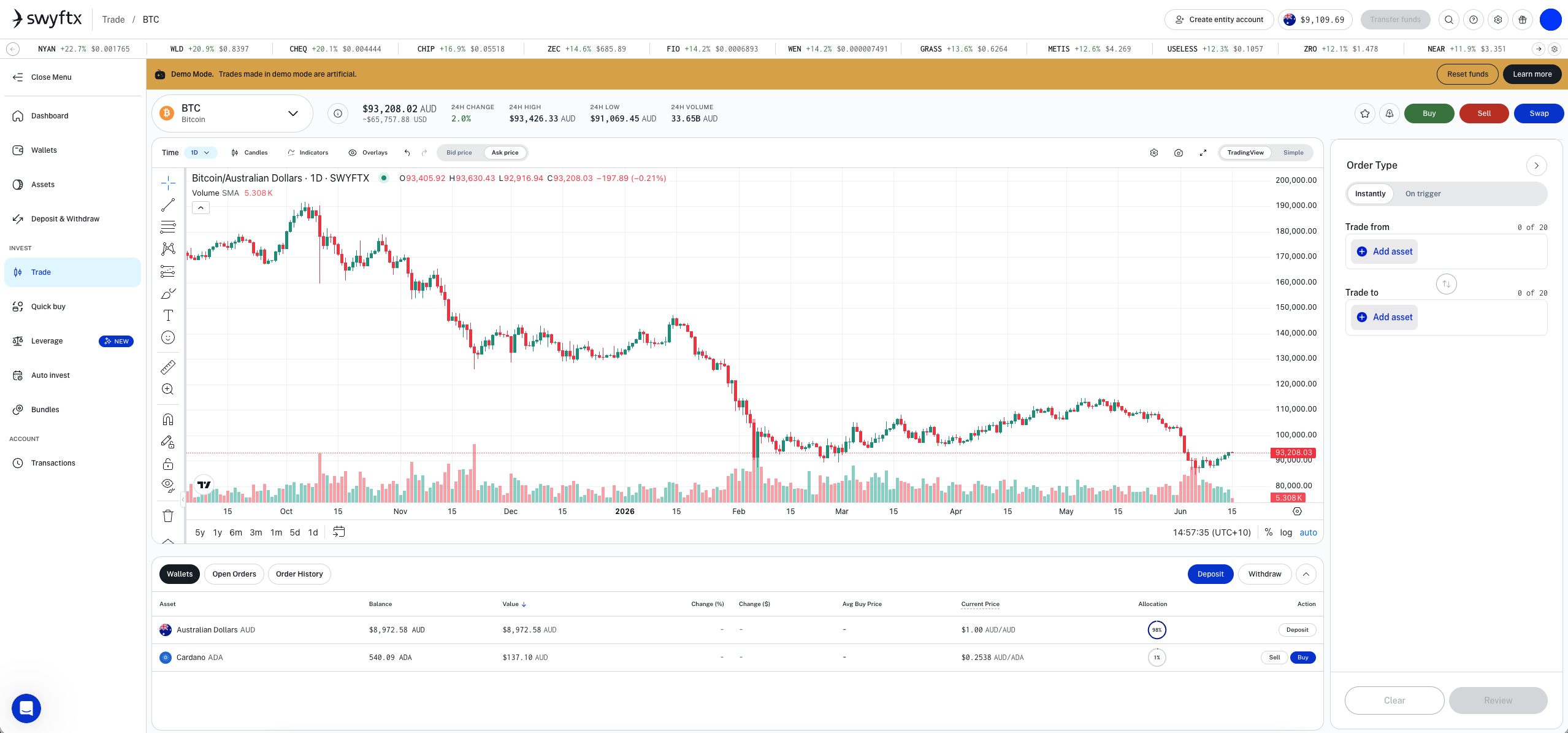
Swyftx’s Demo Mode gives users a $10,000 mock balance to practise with. This allows beginners to test the platform without the fear of losing money while they are still learning how everything works.
That distinction matters. If your demo portfolio doubles, you have not made real money. If it falls heavily, you have not lost real money. The value is in the learning process.
How does Swyftx Demo Mode work?
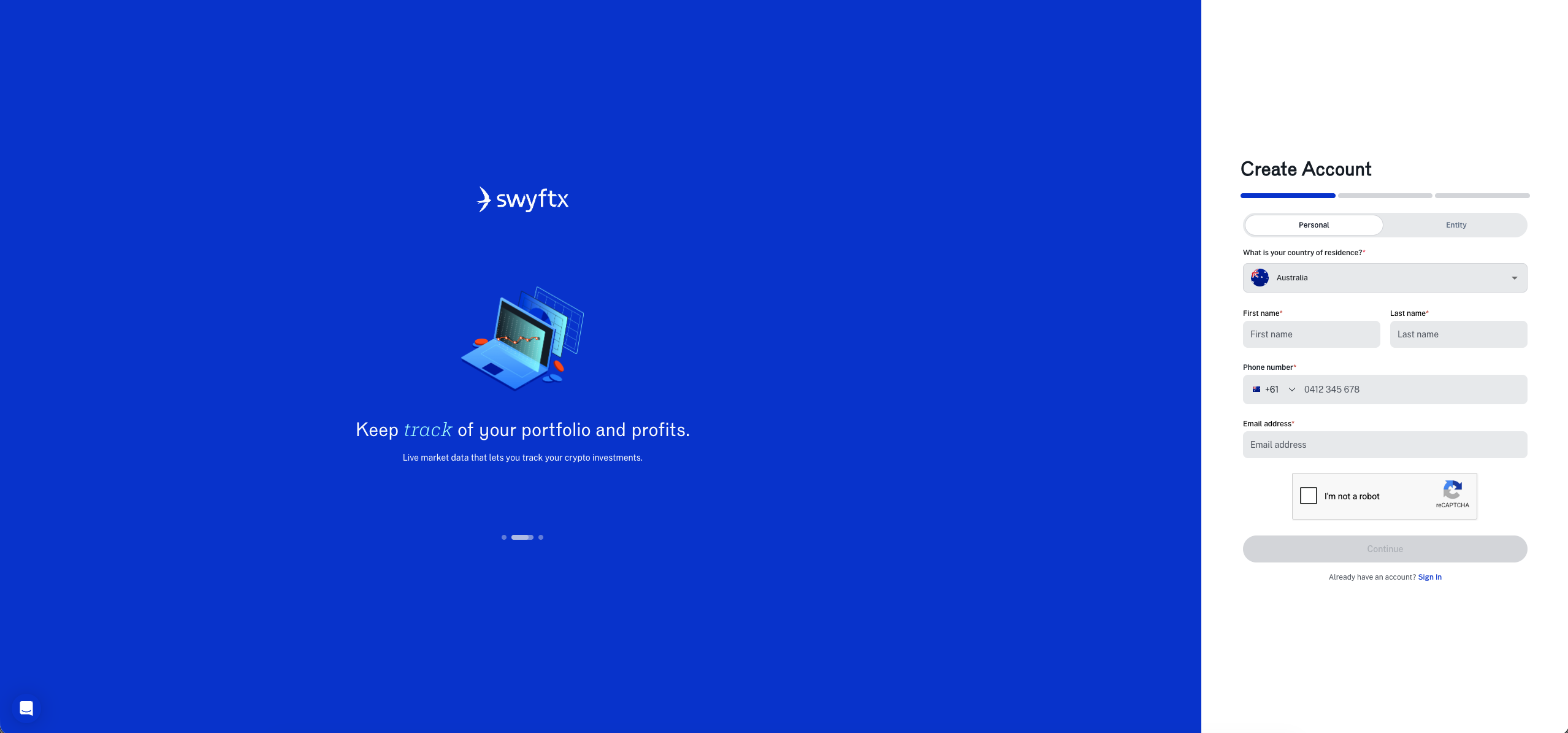
To use Swyftx Demo Mode, you need a Swyftx account. Once inside the platform, you can switch Demo Mode on and begin trading with mock currency.
Swyftx says Demo Mode is available through both its app and web platform. When Demo Mode is active, users can see an indicator showing that they are in the simulated environment. This is important because it helps avoid confusion between practice trading and live trading.
Once Demo Mode is switched on, you can use the mock balance to practise buying and selling crypto assets. You can also explore how the dashboard works, view charts, monitor your portfolio, and get used to the general layout of the platform.
For someone who has never used a crypto exchange before, this can be more useful than simply reading guides. It gives you a hands-on way to understand what happens when you place an order, how balances change, and how quickly prices can move.
You can sign up to Swyftx here and explore whether Demo Mode is useful for your own learning process.
Why beginners may benefit from using Demo Mode first
The biggest benefit of Swyftx Demo Mode is that it gives beginners room to make mistakes without those mistakes costing real money.
That may sound simple, but it is important. New crypto users often make mistakes because they are unfamiliar with the platform, not because they are reckless. They may not understand how order screens work. They may confuse different assets. They may not know how to read their portfolio balance. They may not realise how quickly prices can move.
Demo Mode lets users go through these learning moments in a lower-pressure environment.
It can also help reduce hesitation. Some people spend weeks or months thinking about buying crypto, but never take action because they are worried about doing something wrong. Practising in Demo Mode can make the platform feel more familiar. By the time the user places a live trade, the process itself may feel less intimidating.
Another benefit is that Demo Mode can show beginners how volatile crypto can be. Watching a mock portfolio rise and fall can be eye-opening. Even when the money is not real, users may notice how often prices move and how tempting it can be to check the account repeatedly.
That experience can help users understand whether they are comfortable with crypto volatility before committing real money.
What can you practise in Swyftx Demo Mode?
Swyftx Demo Mode can be used for more than just placing a pretend buy order. It can help users practise several parts of the crypto investing process.
Practising buy and sell orders
The most obvious use is practising how to buy and sell crypto. A beginner can choose an asset, enter an amount, place a simulated order, and see how the position appears in their portfolio.
This helps remove the fear of pressing the wrong button when real money is involved later. It also helps users understand the basic mechanics of moving from cash to crypto and back again.
Exploring different crypto assets
Swyftx offers access to hundreds of crypto assets, and Demo Mode gives users a way to browse and compare them before buying live.
A beginner might start by looking at well-known assets such as Bitcoin, Ethereum, or Solana. They might then compare these with smaller or more speculative coins. This can help them see that not all crypto assets behave the same way.
Some assets may move relatively steadily compared with the broader market. Others may be far more volatile. Demo Mode gives users a way to observe this without taking financial risk.
Tracking a portfolio
Another useful feature is portfolio tracking. Once you make simulated trades, you can watch how your mock portfolio changes.
This can teach beginners about allocation. For example, putting the entire demo balance into one asset will feel very different from spreading it across several. A concentrated portfolio may rise faster if that asset performs well, but it may also fall faster if that asset drops.
This is a useful lesson before real money is involved.
Testing alerts, charts, and watchlists
Demo Mode can also help users get used to market tools such as charts, price alerts, and watchlists. These features may seem confusing at first, but they become easier to understand when you use them in context.
For example, a beginner could set a price alert on an asset they are watching, then observe what happens when the market approaches that level. They could also use charts to compare short-term price movements with longer-term trends.
The aim is not to become an expert trader overnight. It is to become more comfortable using the tools available.
Demo Mode and trading psychology
One underrated benefit of demo trading is that it can reveal emotional patterns.
Even though the money is simulated, many users still notice emotional reactions. They may feel excited when a mock position rises. They may feel annoyed when it falls. They may be tempted to chase a coin that has already gone up. They may keep checking the portfolio even though nothing has really changed.
This matters because crypto is not only a technical or financial challenge. It is also psychological.
Real-money trading brings stronger emotions, but Demo Mode can still offer clues about your habits. Are you impatient? Do you keep changing your plan? Do you go all-in too quickly? Do you sell after a small drop, then buy back higher? Do you ignore your own rules?
These behaviours are easier to notice when they are not costing you money.
A good way to use Swyftx Demo Mode is to set rules before making simulated trades. For example, decide how much of the mock balance you will put into one asset, when you would take profits, and when you would exit a losing position. Then see whether you actually follow your plan.
If you cannot follow a plan with demo money, it may be even harder with real money.
Using Demo Mode to test a simple strategy
Demo Mode is not just for learning how buttons work. It can also be used to test basic investing ideas.
For example, a beginner could use the mock balance to compare two different approaches.
Portfolio A might be simple and conservative by crypto standards: mostly Bitcoin and Ethereum, with a small amount in other large-cap assets.
Portfolio B might be more speculative: a wider mix of smaller coins, higher-volatility assets, and trending sectors.
After a few weeks, the user could compare how the two portfolios behaved. Which one had larger gains? Which one had larger losses? Which one felt more stressful to watch? Which one was easier to understand?
Another approach is to practise dollar-cost averaging. Instead of using the full mock balance at once, the user could pretend to buy a set amount each week. This can help demonstrate how gradual buying works compared with investing everything on one day.
You could also practise exit planning. For example, you might decide to sell part of a mock position if it rises by a certain percentage, or cut a position if it falls beyond a pre-set level.
The goal is not to prove that a strategy will work forever. Markets change. Demo results do not guarantee live results. But testing ideas in Demo Mode can help you learn how different approaches behave.
What Demo Mode cannot teach you
Swyftx Demo Mode is useful, but it has limits.
The biggest limitation is that mock money does not feel the same as real money. Losing $1,000 in demo funds is very different from losing $1,000 of your own savings. Because the emotional pressure is lower, users may take risks in Demo Mode that they would never take in real life.
This can create false confidence. Someone may make a large mock profit and assume they are ready to trade aggressively. That can be dangerous. A good demo result may be due to timing, luck, or favourable market conditions rather than skill.
Demo Mode also cannot remove the practical risks of live trading. When you move to real money, fees, spreads, liquidity, tax, and execution all matter. Crypto markets can move quickly, and the price you expect may not always be the outcome you receive.
There is also the broader risk of crypto itself. Digital assets are volatile. Prices can fall sharply. Some projects fail. Regulation can change. Investor sentiment can shift quickly.
Demo Mode is best viewed as a learning tool, not a guarantee. It can help you understand the platform and practise decision-making, but it cannot make crypto investing safe.
Who should use Swyftx Demo Mode?
Swyftx Demo Mode may be useful for several types of users.
The first group is complete beginners. If you have never bought crypto before, Demo Mode gives you a way to understand the process before depositing funds.
The second group is people who have opened an account but feel nervous about their first trade. Rather than rushing into a live order, they can practise first and become familiar with the platform.
The third group is users switching from another exchange. Even experienced crypto users may benefit from learning how Swyftx’s layout, order screens, portfolio tools, and account features work before trading live.
The fourth group is anyone testing a new approach. If you want to try a different portfolio structure, practise using price alerts, or test a more disciplined trading plan, Demo Mode can be a useful sandbox.
It is less useful for people who treat demo profits as proof that they can beat the market. The more useful mindset is curiosity: “What can I learn before using real money?”
How to move from Demo Mode to real trading carefully
If you use Demo Mode and feel ready to start live trading, the next step should still be cautious.
A good approach is to start small. You do not need to invest a large amount just because you understand the platform. The first live trade can be more about learning how real-money execution feels than trying to make a major profit.
Before switching from demo to live trading, it is worth asking:
- How much am I prepared to risk?
- Do I understand the asset I am buying?
- Have I checked the current fees?
- Do I have a plan for when I might sell?
- Am I buying because I have a reason, or because the price is moving?
- Would I still be comfortable if the asset dropped sharply?
You should also understand the difference between practising with mock funds and trading with real capital. In Demo Mode, a bad decision is a lesson. In live trading, a bad decision can have financial consequences.
That does not mean beginners should be scared away from learning. It means the transition should be deliberate.
If you decide Swyftx suits your needs, you can create an account using this Swyftx link. Just remember that opening an account and placing a live trade are separate decisions. You should only trade if it suits your circumstances and risk tolerance.
Swyftx Demo Mode vs learning by trial and error
Some people learn crypto by trial and error with real money. They deposit funds, place trades, make mistakes, and slowly figure things out.
That can work, but it can also be costly.
A demo account moves some of that trial and error into a safer environment. You can learn where features are, how trades appear, how your portfolio updates, and how volatile different assets can be without putting your own money at risk.
This is especially useful in crypto because the market can be unforgiving. Prices can move at any time, and beginners may feel pressured to act quickly. Demo Mode slows the process down and gives users space to learn.
It is not a replacement for research. It is not a guarantee of success. But compared with learning every lesson using real funds, it is a more forgiving place to start.
Bonus: get $20 of free Bitcoin when you sign up
Here’s something worth knowing before you start. When you sign up to Swyftx using our link, you can claim $20 of Bitcoin for free — and you don’t even need to make a deposit. All you have to do is verify your ID.
That means you can practise trading in Demo Mode for free and have $20 of real Bitcoin to trade with when you’re ready, if that’s what you want to do. Or you can simply hold the BTC. For the full step-by-step, see our Swyftx referral code guide.
Final thoughts: practise before the pressure is real
Swyftx Demo Mode is a practical feature for anyone who wants to understand crypto trading before using real money. It allows users to practise with mock funds, explore the platform, test ideas, and observe how crypto prices move in a simulated environment.
For beginners, that can make the first step into crypto less intimidating. Instead of learning everything under pressure, they can build familiarity first.
The main thing is to use Demo Mode properly. Do not treat it as a game. Treat it as practice. Set rules. Test ideas. Notice your emotional reactions. Learn how the platform works. Then, if you decide to trade live, start carefully and only use money you can afford to risk.
Crypto investing still carries risk, and demo trading does not change that. But preparation matters. The more you understand before your own money is involved, the less likely you are to make rushed decisions later.
If you want to explore the platform, you can sign up to Swyftx here and try Demo Mode before deciding whether live trading is right for you.