
What is a crypto portfolio tracker app?
Many serious cryptocurrency investors and traders use a variety of different crypto exchanges to trade, and they store their assets in various wallets. You may use one wallet for staking ADA, a hard wallet for long-term Bitcoin storage, and you might keep some on a crypto exchange so you can stake it. Due to your digital assets being spread across different places, and the volatile nature of cryptocurrency, it can be hard to keep track of how much crypto you own. That’s where a crypto portfolio tracker comes in handy. You use the app to store information about all your crypto, including the amount, the current price and your profit or loss. Once you have linked your crypto exchanges to the app, any trades you make are automatically updated in your crypto portfolio tracker.
In this article we compared many different crypto portfolio tracker apps and compiled a list of the best ones. Whether you want a free or paid app, a desktop or mobile tracker, we have found something for you.
Top Crypto Portfolio Tracker Apps
| Crypto Portfolio Tracker | Features | Score | Sign Up |
|---|---|---|---|
Best crypto portfolio tracker |
CoinStats
☑️ Links with over 500 crypto exchanges and wallets ☑️ Supports over 8,000 cryptocurrencies ☑️ Trade crypto from directly within the app |
9.8 | Sign Up |
Track all your investments |
Delta
☑️ Supports over 7,000+ different cryptocurrencies ☑️ Connects with over 10,000 brokers, exchanges and wallets ☑️ Track all your investments, such as crypto, stocks, forex and options |
9.6 | Sign Up |
Best for frequent traders |
Coin Market Manager
☑️ Detailed journaling and analysis to improve trading strategies ☑️ Free access if you link to a referral exchange, such as Binance ☑️ Discounted trading fees on crypto exchange when linked to Coin Market Manager |
9.4 | Sign Up |
Best for tracking net wealth |
Kubera
☑️ Track all assets including bank accounts, houses and cars ☑️ Connects to the most popular wallets and exchanges such as Trezor, Ledger, Binance, Coinbase and more ☑️ “Dead Man’s Switch” feature so you can leave your wealth to your beneficiary |
9.2 | Sign Up |
#1. CoinStats – Best Crypto Portfolio Tracker Overall
CoinStats started out in 2017 as a cryptocurrency research provider, but now it’s most well-known as a crypto portfolio tracker app. You can use it on desktop and mobile, giving you ultimate convenience, and has over 1 million users around the world.
CoinStats can link up with almost any cryptocurrency exchange or wallet, with 500 supported, including the most popular ones: Binance, MetaMask, Trust Wallet, Coinbase, Kraken, KuCoin and Bitstamp. Using CoinStats you can track over 8000 different cryptocurrencies, and even allows you to trade crypto directly from the app, without logging into the exchange. To ensure this is done safely, all API keys are stored in an AWS Vault Service so no funds can be stolen.
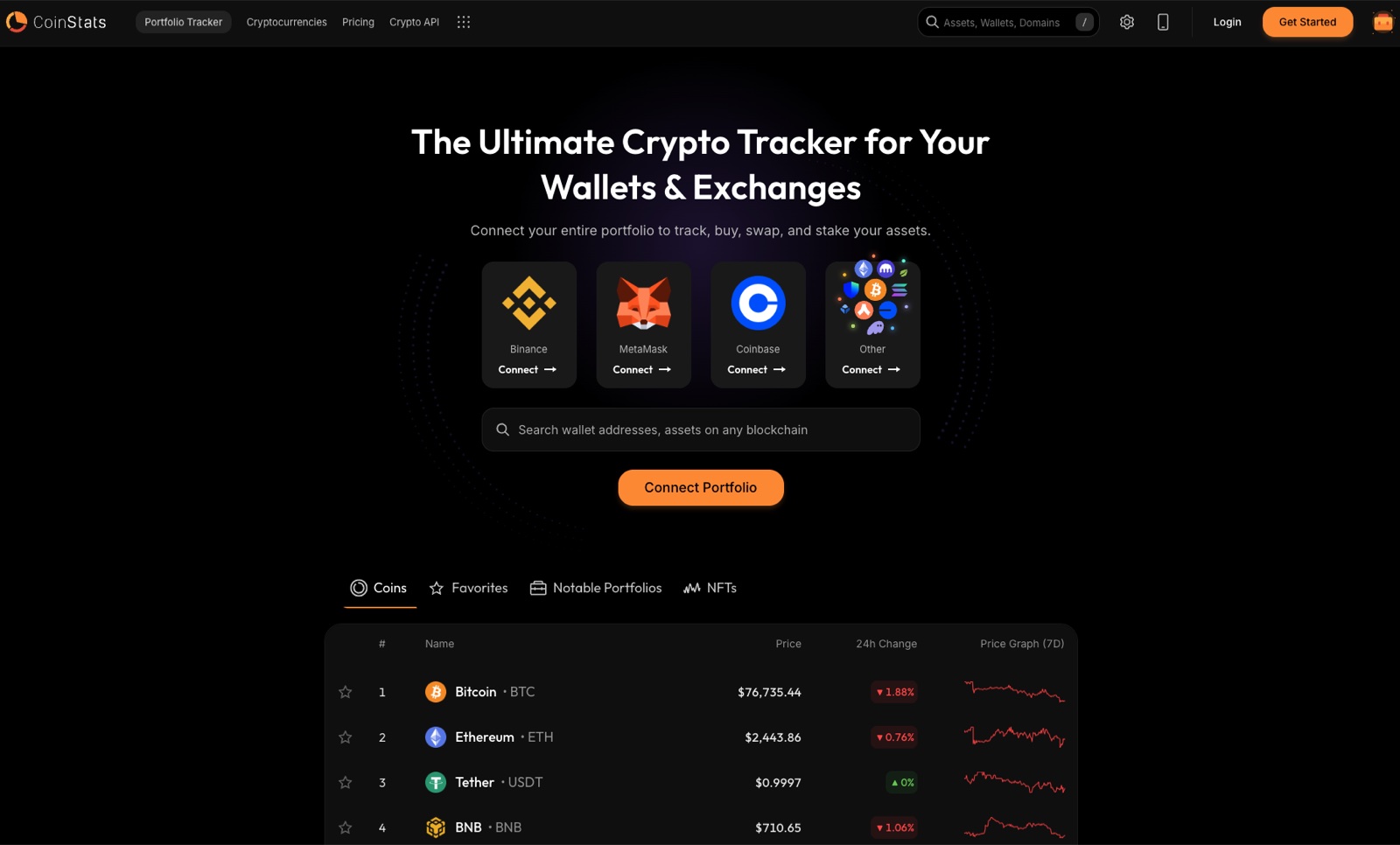
CoinStats restructured its plans and now runs four tiers rather than two. Basic is free and covers 10 portfolios and 20,000 transactions, which is more than enough for most people. Premium is $13.99 per month and lifts that to 100 portfolios with priority support and the AI research tools. Above that sit Degen, aimed at heavy traders with 500 portfolios and VIP support, and Team, which is custom priced. There is a seven-day full-access trial, and annual billing brings the higher tiers down by roughly 29%. Note that the older Pro tier no longer exists.
Pros
- Support for over 500 exchanges and wallets
- Trade cryptocurrencies directly from within the app
- Over 8000 cryptocurrencies supported
- Unlimited exchange and wallet connections with Premium service
Cons
- The genuinely useful AI and multi-portfolio features sit behind the paid tiers
#2. Delta – Best for Tracking All Investment Types
Delta is a very popular crypto portfolio tracker launched in 2017, long before the devastating COVID-19 strain of the same name. In 2019, the popular US trading platformeToro took over Delta, and now the app tracks over 7000 cryptocurrencies.
Delta is great to use, with connections to over 10,000 brokers, exchanges, banks and wallets, such as eToro, Binance, Kraken, Gemini and KuCoin, and you can set up different portfolios, to track separate owners, or different strategies.
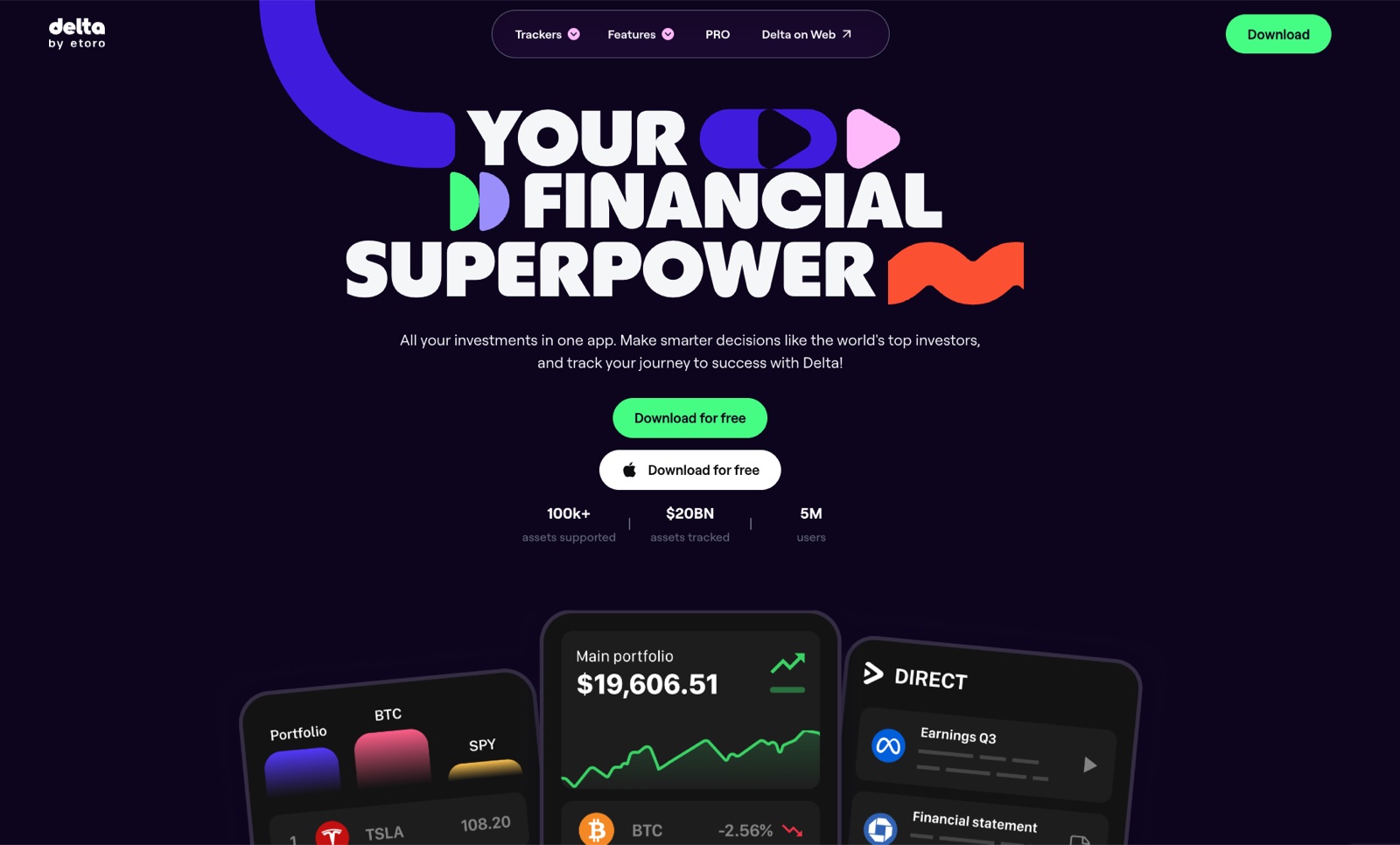
Delta is available to download as a mobile app from the Apple Store or Google Play Store, and you can also activate a desktop version after you have set up the mobile app. Now branded Delta by eToro, the app keeps a free version and repriced its paid plans in 2026 into two tiers: PRO at $53.88 per year and PRO+ at $107.88 per year. The free version still works for basic tracking but limits how many connections you can hold, while the paid tiers add unlimited connections to exchanges, wallets and brokers, live prices and the deeper portfolio analytics.
Pros
- Support for over 7,000 different cryptocurrencies
- Track all your investments, including stocks, forex, and options
- Syncs with over 10,000 brokers, exchanges, banks and wallets
- Free version available
Cons
- Can only link 2 exchanges with the free version of the app
#3. Coin Market Manager – Best for Frequent Traders
Coin Market Manager is an excellent choice for those that are looking for more than just a crypto portfolio tracker. Coin Market Manager is perfect for those who consider themselves traders rather than investors. It is an excellent automatic journaling and analytics tool, that can help you improve your trading strategies by highlighting your strengths and weaknesses.
The detailed trade analytics, advanced charts, and auto-sync of trade data are incredibly useful and many users report success after tweaking their trading strategies. Coin Market Manager is compatible with Binance, Bybit, Deribit, BitMEX and Coinbase.
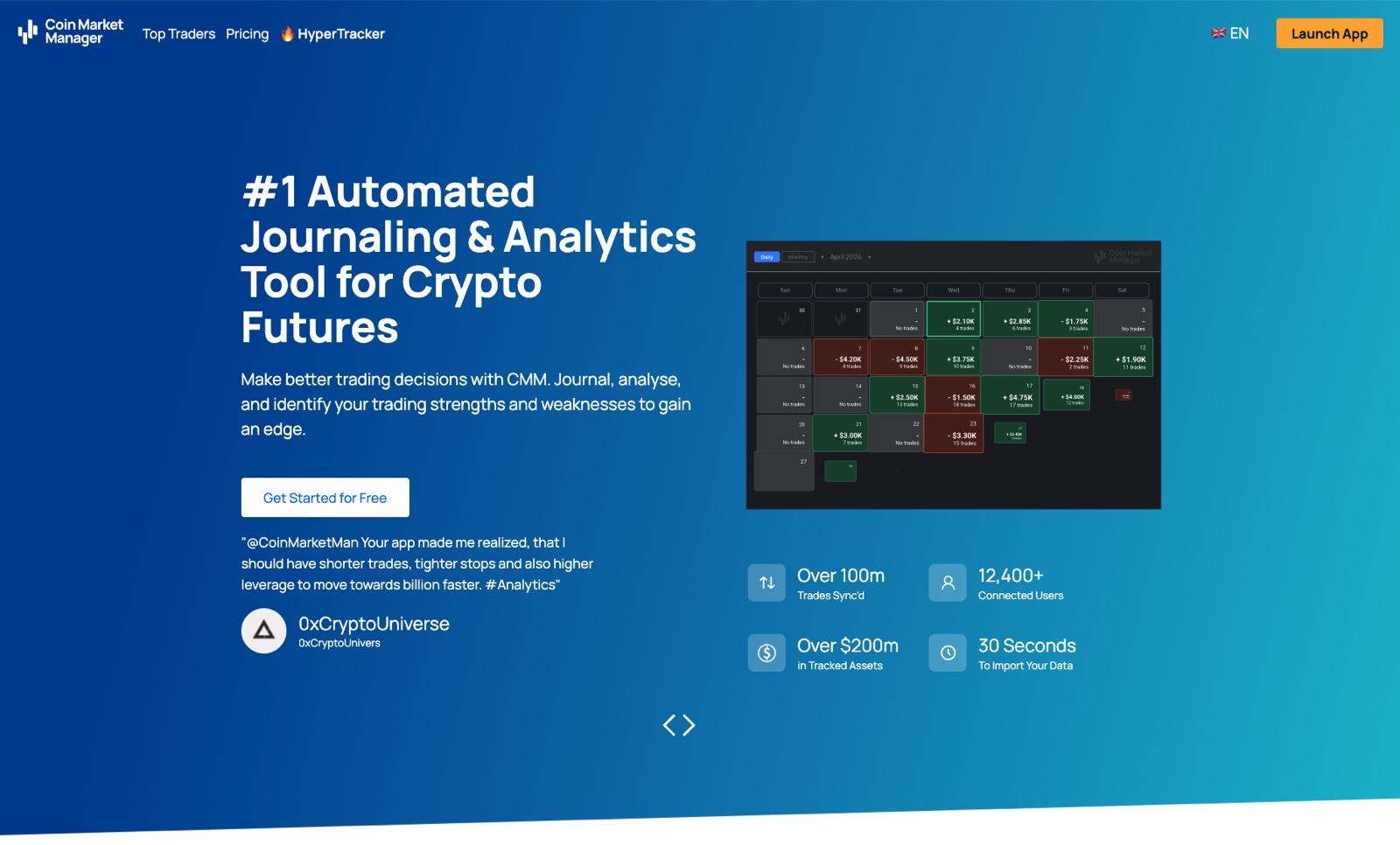
Coin Market Manager keeps a free BASIC plan, which connects a single exchange account and is aimed at casual traders. Full functionality means PRO at $699.99 per year or ENTERPRISE at $899.99 per year, the latter adding unlimited exchange connections. Note these are annual prices, not monthly. The cost is quite steep, but wait, there’s an easy way to receive FULL functionality for FREE forever. All you have to do is connect your Coin Market Manager account with one of the referral exchanges: Binance, Deribit or Bybit. Not only do you receive free unrestricted Coin Market Manager access, you also receive discounted trading fees on the exchange.
Pros
- Detailed journaling and analysis which is great for improving trading strategies
- Free access if you link to one of their referral crypto exchanges, such as Binance
- Discounted trading fees on crypto exchange if you link it to Coin Market Manager
- Available on desktop
Cons
- No mobile app, but you can access the site through your phone browser
- Can only connect to a small number of crypto exchanges
#4. Kubera – Best for Tracking Net Wealth
While Delta is great for tracking all your investments, such as stocks and forex, Kubera goes a step further. Not only does Kubera track all your investments, it tracks all your assets, including money in bank accounts, your home value, your cars, and even a market value of your web domain names. In other words, it provides a snapshot of your net wealth.
For your cryptocurrency, Kubera connects to your exchange or wallets to automatically sync your data. Some of the connections they support include Binance, Kraken, Trezor, Coinbase, MetaMask, Ledger and Gemini. Since Kubera stores so much of your sensitive information, it meets all the requirements for Bank Grade Security, so you don’t need to worry about it getting into the wrong hands.
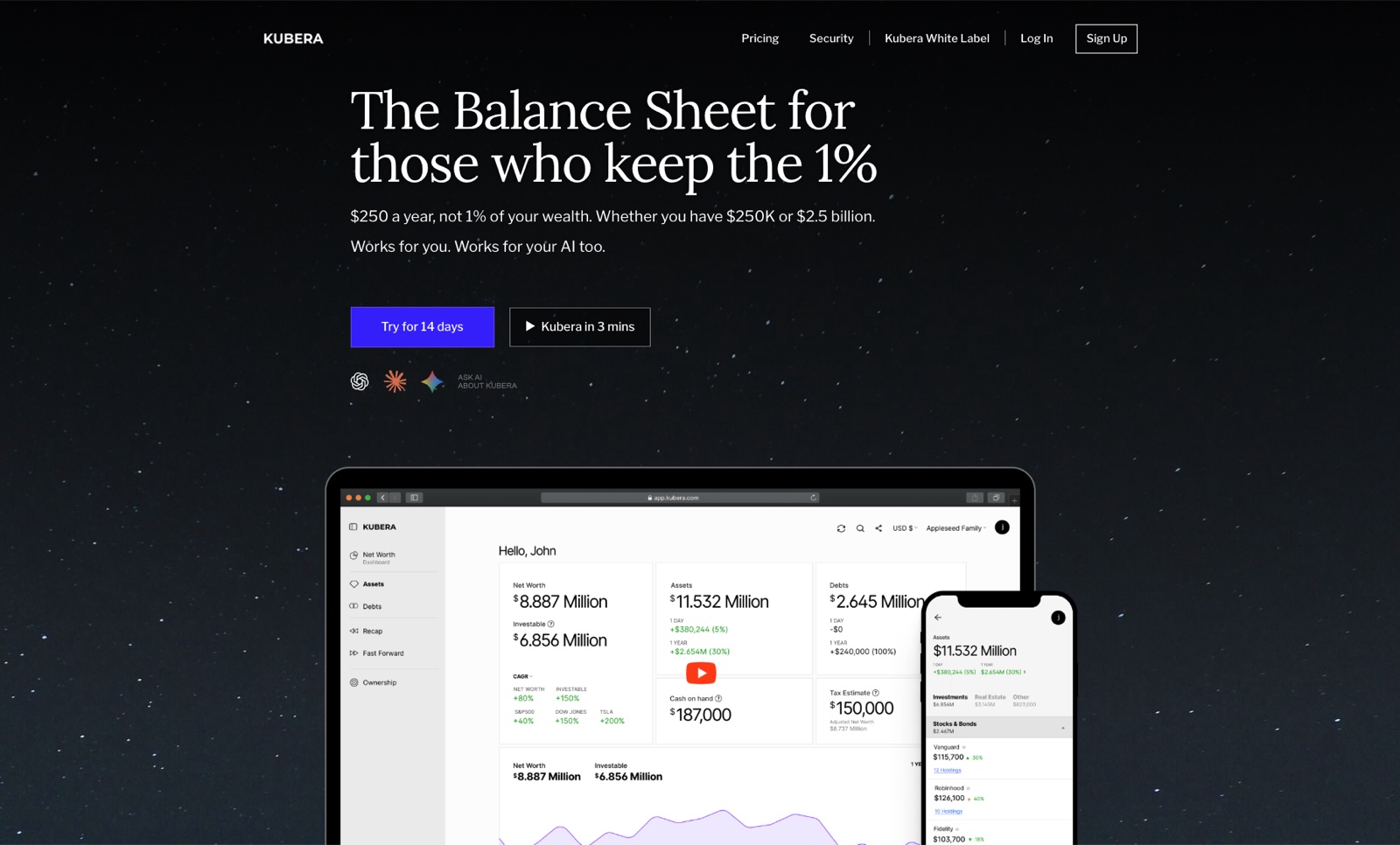
Kubera offers a free 14-day trial with full access, after which Essentials costs $250 per year and the Black tier, which adds ownership tags, nested portfolios and VIP support, costs $2,500 per year. It is the most expensive option here by some distance, and it is priced as a whole-of-wealth tracker rather than a crypto tool. This is definitely a great option for high net worth individuals that want to keep track of all their assets including their crypto in one spot.
Pros
- Keep track of all assets including bank accounts, houses and cars
- “Dead man’s switch” feature so you can leave your wealth to your beneficiary
- Connects to the most popular exchanges and wallets such as Binance, Gemini, Coinbase, Ledger and Trezor
Cons
- Costs $250 per year, the most expensive tracker here
- No mobile app, but can be accessed from your phone browser
Should I use a crypto portfolio tracker?
It is completely up to you if you decide to use a crypto portfolio tracker or not. If you do not have your cryptocurrency spread across various wallets and exchanges, then you may not need to use one. Also, if you plan to HODL your crypto for the long term, maybe it is better not to constantly keep an eye on your holdings, as you may be tempted to sell it when the prices fluctuate. You can always try out a free one first to see if you like it, before deciding whether you should pay for a more feature-packed tracker.
How to decide on a crypto portfolio tracker?
If you have made up your mind that you want to use a crypto portfolio tracker, how do you know which one to choose? You need to take a look at what is important to you, and check whether the trackers have what you need. For example, you may want to look at the cryptocurrencies that are supported, which crypto exchanges and wallets they can connect to, and how frequently they update the data. You may also want to look at the cost – are you looking for a free or low-cost option, or are you happy to spend a bit more? Do you want to track only your cryptocurrencies or other traditional assets as well? Our guide has a few of the best crypto portfolio trackers available, depending on what your personal needs are.
Are crypto portfolio trackers safe?
Generally speaking, crypto portfolio trackers are safe, but you will want to choose one that has high security features such as multi-layered encryption and 2FA. If you want to be extra safe, and you are not a frequent trader, you can opt to manually input the coins you have purchased and sold, as opposed to automatically syncing it with your exchanges and wallets. This means the crypto portfolio trackers do not have access to your crypto accounts.
Where should I buy cryptocurrency?
There are plenty of options on where to buy cryptocurrency, based on what you are looking for. For a list of the best crypto exchanges, read our review here. If you have already decided which crypto portfolio tracker app you want to use, then make sure that the crypto exchange you choose can link up with it, for ease of use.
Marketplacefairness.org provides all its content for informational purposes only, and this should not be taken as financial advice to buy, trade or sell cryptocurrency or use any specific exchange. Please do not use this website as investment advice, financial advice or legal advice, and each individual’s needs may vary from that of the author. This post includes affiliate links with our partners who may compensate us.
To read our privacy policy click here.