
CoinSpot and Digital Surge are two of the top crypto exchanges for Australians. There are so many ads around with each exchange claiming to be the best, making it hard to choose one to use. Hopefully this head-to-head comparison between CoinSpot and Digital Surge can help you make a decision. This is a close contest, as both exchanges have Live Chat support, a mobile app, and a user-friendly interface, but CoinSpot edges out Digital Surge as it is the most trusted and secure exchange, and offers a wide range of 530 coins.
| Cell |  |
 |
|
Fiat Currencies |
AUD |
AUD |
|
Number of Coins |
530+ |
400+ |
|
Trading Fees |
Market: 0.1%, Instant trade: 1% |
0.1%–0.5% |
|
Daily Deposit Limit |
$100k |
$100k |
|
Deposit Methods |
Cell | Cell |
|
Direct Deposit |
||
|
PayID |
||
|
POLi |
||
|
PayPal |
||
|
Credit Card |
||
|
Debit Card |
||
|
BPAY |
||
|
Cryptocurrency |
||
|
Cash |
||
|
Features |
Cell | Cell |
|
User-friendly |
||
|
Mobile app |
||
|
Demo mode |
||
|
Live Chat |
||
|
Security |
Cell | Cell |
|
2FA |
||
|
Biometric security |
||
|
AUSTRAC registered |
||
|
ISO 27001 certified |
||
|
Offline cold storage |
||
|
Website |
| Cell | |
|
|
Fiat Currencies |
AUD |
AUD |
|
Number of Coins |
530+ |
400+ |
|
Trading Fees |
Market: 0.1%, Instant trade: 1% |
0.1%–0.5% |
|
Daily Deposit Limit |
$100k |
$100k |
|
Deposit Methods |
Cell | Cell |
|
Direct Deposit |
||
|
PayID |
||
|
POLi |
||
|
PayPal |
||
|
Credit Card |
||
|
Debit Card |
||
|
BPAY |
||
|
Crypto |
||
|
Cash |
||
|
Features |
Cell | Cell |
|
User-friendly |
||
|
Mobile app |
||
|
Demo mode |
||
|
Live Chat |
||
|
Security |
Cell | Cell |
|
2FA |
||
|
Biometric security |
||
|
AUSTRAC registered |
||
|
ISO 27001 certified |
||
|
Offline cold storage |
||
|
Website |
Pros
- Most trusted and secure exchange in Australia
- Low trading fees of 0.1% on the market
- User-friendly interface perfect for beginners
- Wide range of 530+ cryptocurrencies supported
- NFT marketplace where you can purchase NFTs using any cryptocurrency
Cons
- Higher instant trade fees of 1%
- Higher spreads than Digital Surge
 Pros
Pros
- Live Chat support team
- Over 400+ cryptocurrencies
- Low trading fees of 0.1%–0.5% and low spreads
- 24/7 Live Chat support
- User-friendly interface perfect for beginners
Cons
- No NFT marketplace
CoinSpot vs Digital Surge Fees
I have compared the various fees for CoinSpot and Digital Surge here. It is important to note the spread (some investors and traders forget), which is the difference between the buy and sell price of a coin. I carried out a test to compare the fees and spread across four of the best Australian crypto exchanges, using my own crypto accounts. I bought $1,000 of 10 different coins on CoinSpot, Digital Surge, Swyftx and Crypto.com, and sold the whole amount of each coin immediately to work out the combined fees and spread. Digital Surge was the clear winner, and you can read about the crypto buying test and detailed results here.
Deposit Fees
CoinSpot charges ZERO fees on AUD deposits using POLi, PayID, or Direct Deposit (via OSKO). However, if you choose to deposit with BPAY there is a 0.9% fee, and if you want to deposit cash, there is a 2.5% fee.
Digital Surge charges ZERO Fees on AUD deposits using PayID. However, if you deposit using POLi there is a fee that ranges from $2 up to a maximum of $3.30.
Trading Fees
CoinSpot charges 1.0% fees when buying or selling cryptocurrency. However, you can access lower fees of 0.1% when you are trading on the market, however you can only access around 16 coins in this manner.
Digital Surge charges 0.1%–0.5% fees (depending on trade volume) when buying or selling cryptocurrency.
Withdrawal Fees
CoinSpot charges ZERO fees for AUD withdrawals to Australian bank accounts.
Digital Surge charges ZERO fees for AUD withdrawals to Australian bank accounts.
Winner – Digital Surge
Digital Surge wins with lower instant trade fees of only 0.1%–0.5% vs CoinSpot’s 1%, and was the winner of ourcrypto buying test, showing lowest combined fees and spreads overall.
CoinSpot vs Digital Surge Deposit Methods
CoinSpot and Digital Surge both offer several methods of depositing funds onto their platforms. Both platforms support PayID, POLi and cryptocurrency.
CoinSpot additionally offers direct deposit, BPAY and cash deposits at a newsagent, which are not supported on Digital Surge.
Winner –CoinSpot
CoinSpot accepts all the payment methods that Digital Surge, plus direct deposit, BPAY and cash deposits, which are not supported on Digital Surge.
CoinSpot vs Digital Surge Features
CoinSpot and Digital Surge are both great Aussie crypto exchanges with lots of features, so I won’t go into depth about all of them. I will outline a few features that differentiate these two exchanges. For more info about all the features you can find on these two exchanges, read the corresponding articles – CoinSpot review or Digital Surge review.
CoinSpot has a market where you can trade cryptocurrencies for only 0.1% fee, as opposed to the 1% fee for buying instantly from the exchange. This 0.1% fee is much lower than the 0.5% fee for buying and selling on Digital Surge. You can access around 15 different cryptocurrencies on the CoinSpot market.
CoinSpot has an NFT marketplace, which is not available on Digital Surge. You can access thousands of NFTs, including popular collections like Bored Ape Yacht Club. An excellent benefit of buying NFTs on CoinSpot is that you can use any cryptocurrency you like. There is no need to waste time swapping your crypto to ETH before you can make a simple NFT purchase.

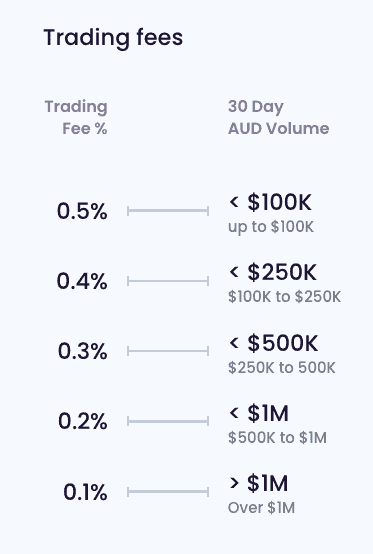
Digital Surge also has a market where you can trade instead of buying and selling from the exchange. The fees start at 0.5% but you can reduce this based on your trade volume over the last 30 days, as shown in the image below. If you are a big trader, with over $1 million volume, you can reduce your fees to only 0.1%.
Digital Surge is slowly taking Australia towards mainstream cryptocurrency adoption, as they allow their users to use Bitcoin to pay for Australian bills or credit cards. This is not possible on most exchanges, and it is a cool feature that saves you time as you don’t need to convert your BTC to AUD before paying for a bill.
Winner –CoinSpot
CoinSpot and Digital Surge are quite similar exchanges – they both have a wide range of coins 24/7 live chat support and a mobile app, but CoinSpot also has an NFT marketplace.
CoinSpot vs Digital Surge Security
CoinSpot and Digital Surge are both very secure Aussie crypto exchanges. They both utilise multilayered security and offline cold storage of assets, ensuring your cryptocurrency is safe from hackers. CoinSpot and Digital Surge are both registered with AUSTRAC, fulfilling all of their strict AML/KYC verification obligations to prevent money laundering and financing of terrorism.
Having said that, CoinSpot is a standout for security, with its proud claim of being the most trusted and secure crypto exchange in Australia. CoinSpot is a certified member of Blockchain Australia, meaning it’s fully compliant with the Australian Digital Currency Industry Code of Conduct. It is also the only Australian exchange to be awarded the ISO 27001 certification after passing stringent auditing.
Winner –CoinSpot
CoinSpot is well-known for being the most trusted and secure Aussie crypto exchange. It is the most audited exchange, and the only one to hold ISO 27001 certification.
Verdict – CoinSpot
CoinSpot and Digital Surge are both fantastic secure crypto exchanges for beginners. They are both very similar in terms of what they offer: a user-friendly interface, mobile app, Live Chat and a wide range of coins. CoinSpot wins this comparison, because it has higher levels of security and trust, NFT marketplace, and offers a wide range of 530+ coins. You can also access $20 FREE Bitcoin if you signup with this link.
If you prefer to use Digital Surge, be sure to sign up with this link to receive FREE $10 Bitcoin.
Overall Winner – CoinSpot
These exchanges are very similar, but CoinSpot is more secure, and has a wider range of 530+ coins.
Still Researching?
If you are still doing your research before committing to a crypto exchange, my article on the best Aussie crypto exchanges can help you out, which you can read here. I have also included a quick comparison table below with some key information.
If you want to read a bit more about CoinSpot or Digital Surge, you can read my in-depth reviews of CoinSpot and Digital Surge.
Comparison Table of the Best Crypto Exchanges in Australia



 Crypto ExchangeCrypto ExchangeBybitCoinSpotSwyftxDigital SurgeCoinstashFiat CurrenciesFiat CurrenciesAUD, USD, GBP, EUR, NZD & moreAUDAUD, NZDAUDAUDCryptocurrenciesCryptocurrenciesBTC, ETH, LTC, XRP, EOS & 280+ moreBTC, ETH, LTC, XRP, BCH, ADA & 530+ moreBTC, BTG, BCH, ADA, ETH, ETC & 440+ moreBTC, ETH, XRP, BCH, LTC & 400+ moreBTC, ETH, DOGE, DOT, XRP, LINK & 1,000+ moreDeposit MethodsDeposit MethodsVisa/Mastercard, Apple Pay, Google Pay, PayID, CryptocurrencyPayID, Direct Deposit, Cash, Card, CryptocurrencyPayID, OSKO, Bank transfer, Credit card, CryptocurrencyPayID, Bank Transfer, CryptocurrencyBank Transfer, PayID, CryptocurrencyTrading FeesTrading Fees0.1% for spot, 0.02/0.055% for derivativesMarket order: 0.1%, Instant buy: 1%0.6%0.1%–0.5%0.85%Visit SiteFull Review Visit SiteFull Review Visit SiteFull Review Visit SiteFull Review Visit SiteFull Review
Marketplacefairness.org provides all its content for informational purposes only, and this should not be taken as financial advice to buy, trade or sell cryptocurrency or use any specific exchange. Please do not use this website as investment advice, financial advice or legal advice, and each individual’s needs may vary from that of the author. This post includes affiliate links with our partners who may compensate us.
To view our privacy policy read this breakdown.